

Langfuse is the better default for most teams, with an open-source MIT core you can self-host for free and framework-agnostic SDKs, while LangSmith wins for teams building on LangChain or LangGraph who want a managed eval suite and the tightest native tracing. LangSmith vs Langfuse comes down to two questions, whether you are committed to the LangChain stack and whether you need your trace data inside your own infrastructure. Both are capable LLM observability tools, so the pick follows your hosting model and framework more than any single feature.
Langfuse is the best overall pick for most teams, open source and cheaper as you scale.
LangSmith wins for LangChain and LangGraph users who want a managed eval suite and native tracing.
Langfuse has the larger free tier, 50K units per month against LangSmith's 5K traces.
Langfuse is the only one with a self-serve self-hosting path, which decides data-residency cases.
Quick Comparison
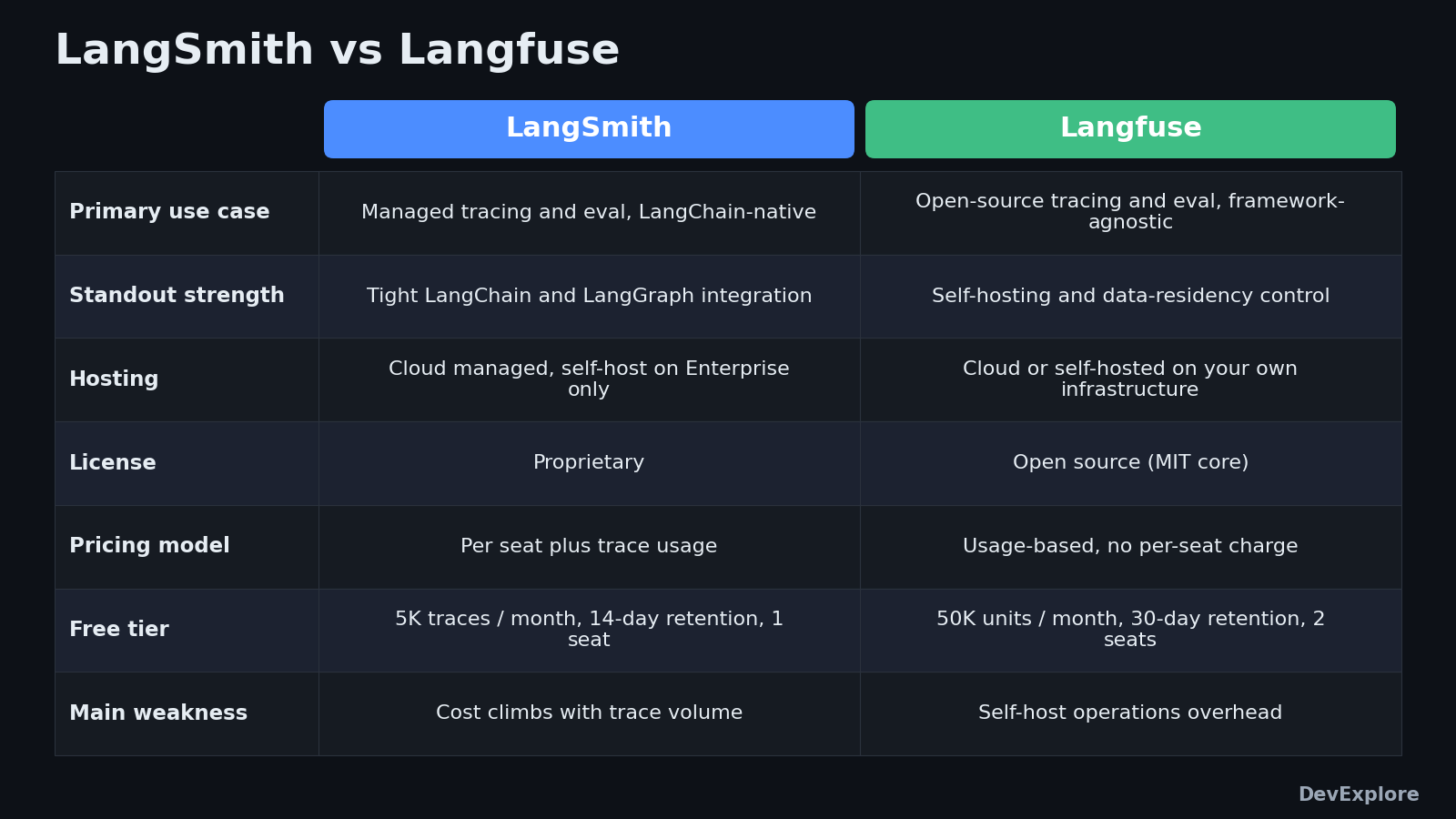
Picking an observability layer for an LLM app comes down to a single fork in the road. You can hand tracing and evaluation to a managed service and move fast, or you can run an open-source stack on your own infrastructure and keep full control of where the data lives. LangSmith sits on the managed side and comes from the LangChain team. Langfuse sits on the open-source side and runs anywhere you can host a container. Both cover the core job of LLM observability tools, recording every model call, scoring outputs, and surfacing failures, so the decision turns on convenience against control.
LangSmith Overview
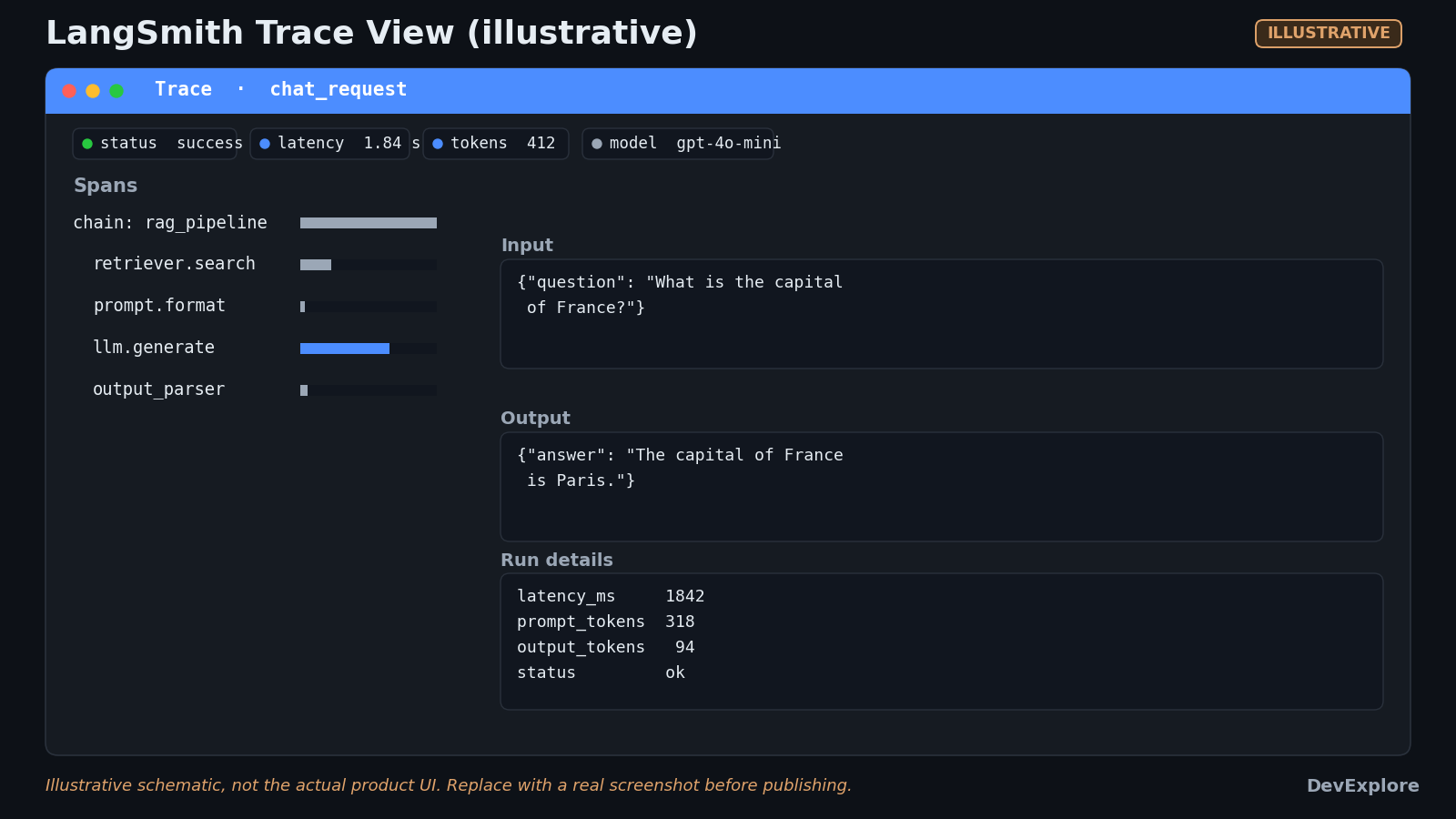
LangSmith is the LangChain team's managed platform for tracing, evaluation, and monitoring of LLM applications. It records each step of a chain or agent run, the inputs, outputs, latency, token usage, and errors, then pairs that with an evaluation suite that scores outputs against datasets. For teams building on LangChain or LangGraph, instrumentation is close to automatic, and LangGraph Studio adds visual step-through debugging of agent workflows. A framework-agnostic path exists through the @traceable decorator and the LangSmith SDK, though teams outside LangChain instrument more by hand and use a smaller slice of the platform. On pricing, LangSmith meters by trace volume and charges per seat, and its free Developer tier covers early work rather than production. As a LangChain tracing tool it is the most direct option, and LangSmith pricing rewards small teams that stay within the included trace volume.
Langfuse Overview
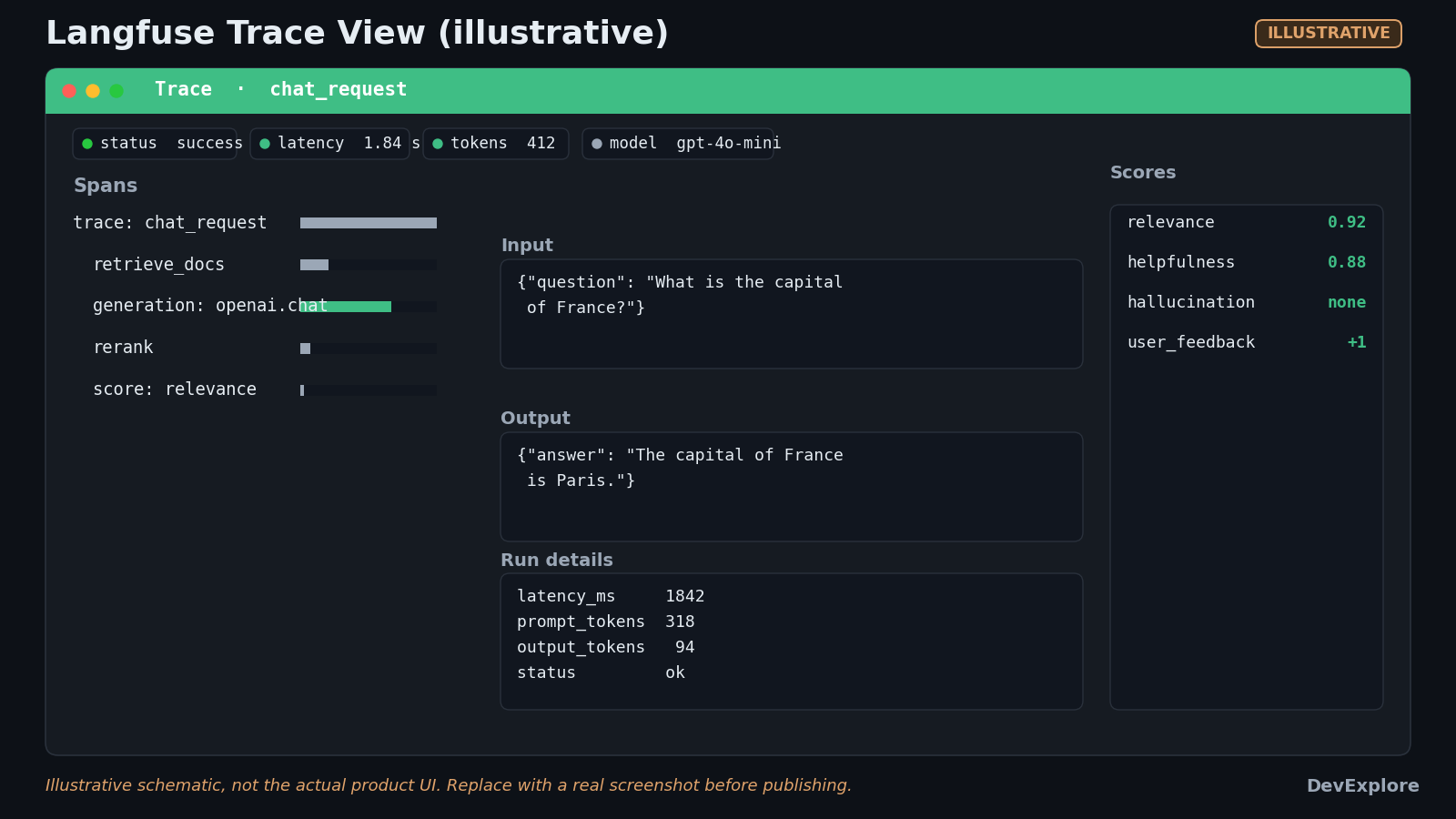
Langfuse is an open-source observability and evaluation platform with an MIT-licensed core you can self-host at no license cost. Its SDKs are framework-agnostic, with native integrations for the OpenAI SDK, the Vercel AI SDK, Pydantic AI, LlamaIndex, and LangChain, so teams that do not use LangChain still get first-class tracing rather than manual wiring. The feature set covers tracing, prompt management, datasets, evaluations, annotation queues, and a playground, most of it under the open-source license. Langfuse Cloud offers the same product as a managed service for teams that prefer not to run infrastructure, and ClickHouse now owns the company with no change to the MIT license or pricing. Self-hosting is the standout for open source LLM observability, since you can keep every trace inside your own perimeter, which is what makes Langfuse a practical base for self-hosted LLM monitoring.
Head-to-Head on Key Dimensions
Tracing and Evaluation
Both tools trace multi-step chains and agents down to individual spans, and both support datasets, evaluations, prompt versioning, and annotation queues for human review. LangSmith's edge is depth inside the LangChain ecosystem, where traces capture chain structure with no manual spans and the eval suite ties directly to LangChain primitives. Langfuse matches that core workflow as an LLM evaluation platform, with trace analysis, an evaluation pipeline built on LLM-as-a-judge scorers, prompt versioning, and an annotation queue, and it applies all of it across any framework through explicit SDK calls. The instrumentation effort differs in practice, which the side-by-side setup below makes concrete.
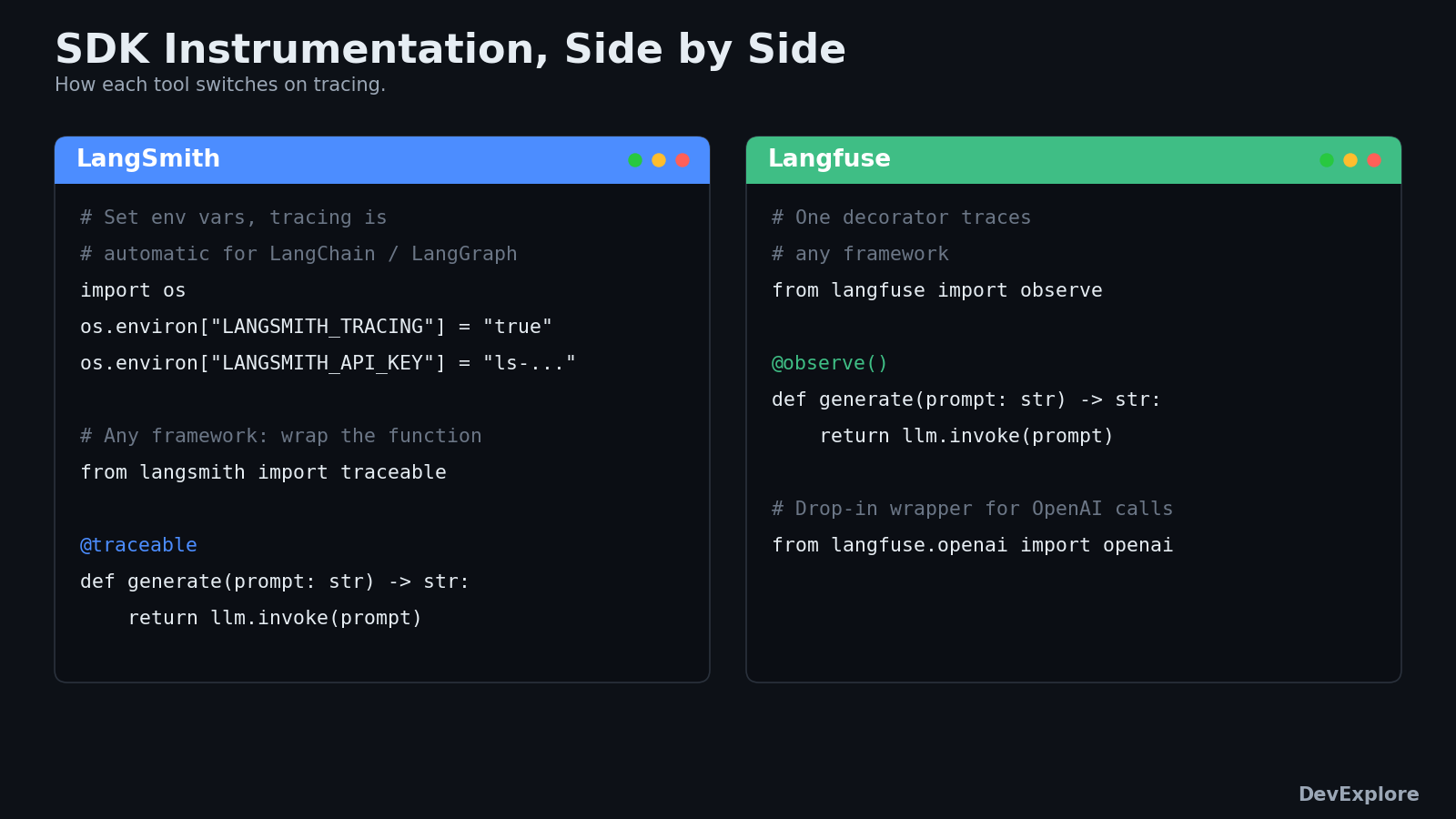
For a LangChain app, LangSmith needs only environment variables to start tracing. Outside that ecosystem both tools rely on a decorator or wrapper, and the work is comparable.
Hosting and Data Residency
Hosting is where Langfuse separates itself. LangSmith runs as a managed cloud service, and self-hosting is available only on the Enterprise plan through a sales contract, so a regulated team that needs trace data inside its own network on day one has no self-serve route. Langfuse ships a self-hostable, MIT-licensed build that runs on your own infrastructure with unlimited events and users, which keeps prompts, completions, and user data inside your boundary and shortens compliance reviews for SOC 2, HIPAA, or GDPR scope. The cost is operational, since a Langfuse self-host depends on PostgreSQL, ClickHouse, Redis, and object storage that your team runs and maintains. When data residency is a hard requirement, Langfuse is the clear pick.
Pricing
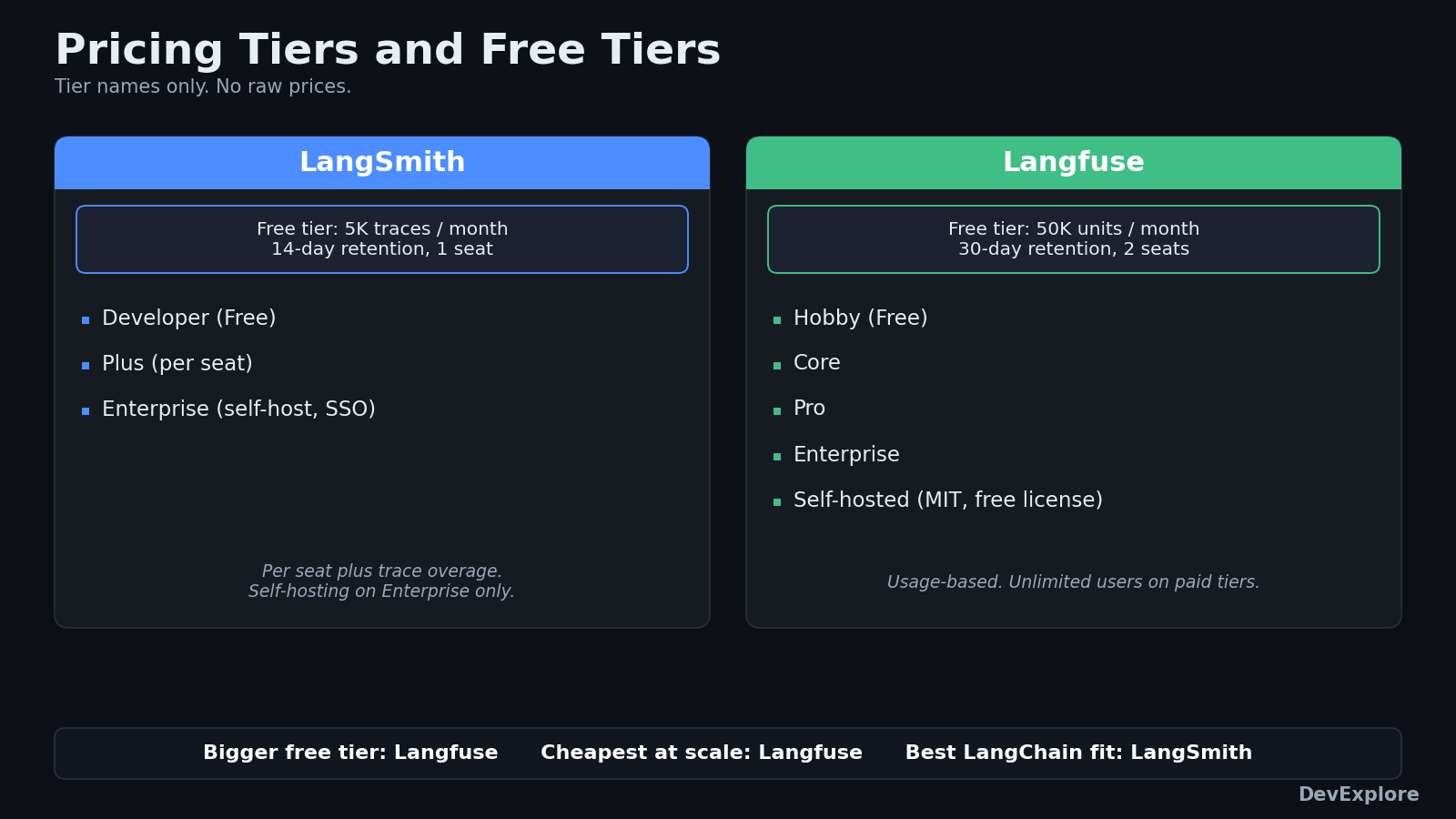
LangSmith uses per-seat pricing plus trace-based metering. The free Developer tier includes 5,000 traces per month, 14-day retention, and a single seat, the Plus tier adds more traces and seats with overage on top, and Enterprise is custom-quoted and unlocks self-hosting, SSO, and longer retention. Because LangSmith counts every run inside a chain, the effective LLM cost per call rises for agent-heavy apps that fan out into many steps.
Langfuse prices on usage units with no per-seat charge, so adding teammates does not raise the bill. Its Hobby tier is free with 50,000 units per month, 30-day retention, and two seats, Core and Pro add volume, retention, and compliance certifications, and self-hosting under the MIT license carries no software cost at all, only the infrastructure you run. For a mid-sized team with steady production traffic, Langfuse lands well below LangSmith on total cost, which is why many teams start on Langfuse and move to LangSmith only when tight LangChain integration earns the switch.
Which One to Pick
Pick LangSmith if your stack runs on LangChain or LangGraph, you want tracing that works with no manual spans, and you value the managed eval suite and LangGraph Studio debugging enough to accept per-seat and trace-based costs. Pick Langfuse if you need self-hosting or data residency, you run a framework other than LangChain, you want an open-source core you can read and extend, or you want cost to stay flat as the team grows. Asking which is better for production, LangSmith or Langfuse, usually resolves on those two axes rather than raw feature counts. For a team with moderate production traffic and no hard LangChain dependency, Langfuse is the stronger starting point, and moving to LangSmith later is straightforward once the LangChain-native features justify the price.
Bottom Line
Langfuse is the default recommendation for most teams, the open-source alternative to LangSmith that runs anywhere, prices on usage rather than seats, and keeps data under your control. LangSmith earns its place when you are committed to LangChain or LangGraph and want the managed eval suite and native tracing that come with it. Choose by hosting model and framework first, and the rest follows.